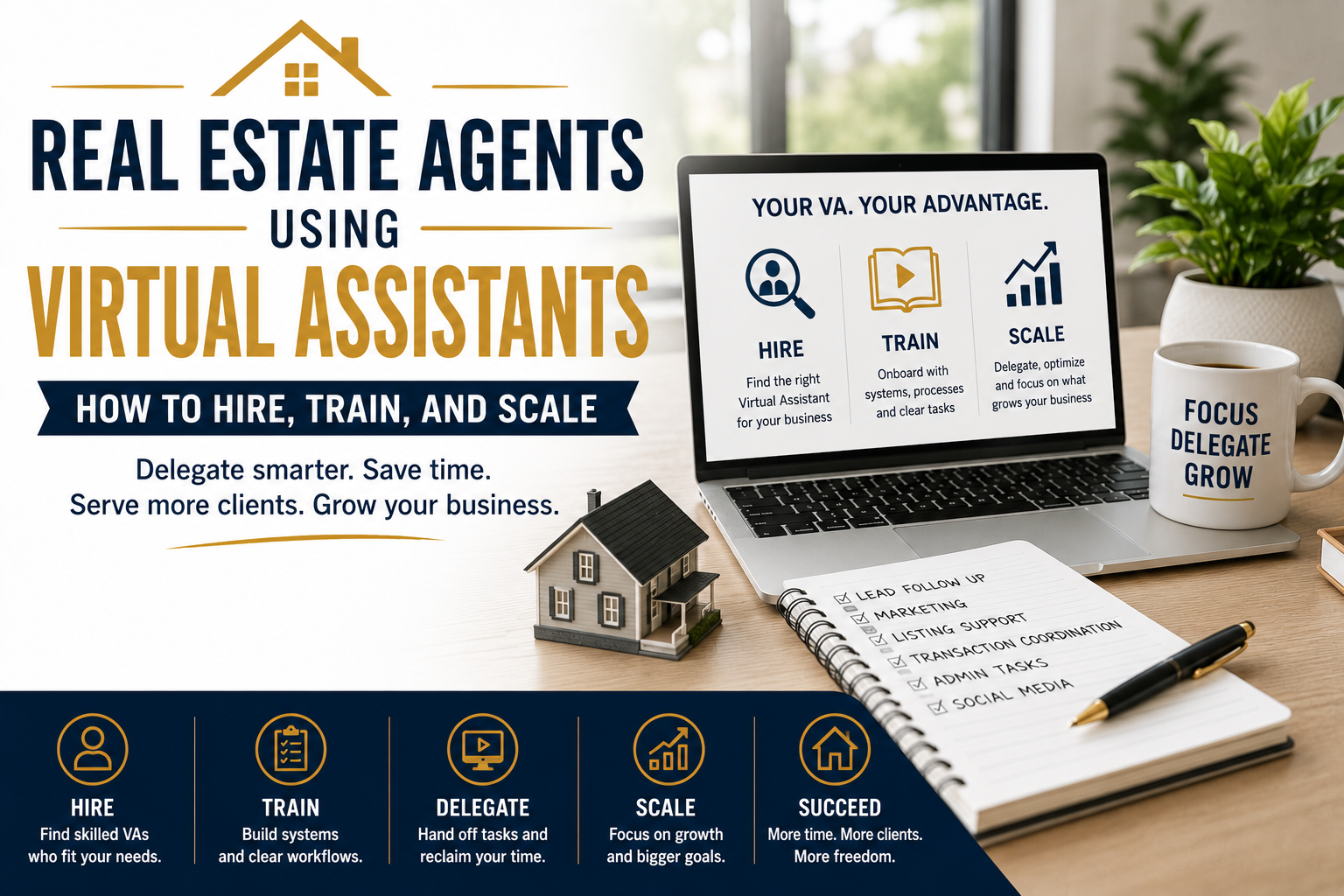
Real estate agents using virtual assistants are breaking through the ceiling that stops most agents from scaling — and it’s not the ceiling you’d expect. It’s not leads. It’s time, bandwidth, and the sheer volume of tasks that pile up when your business starts to grow. After 28 years in this business, I can tell you: the agents who figure out leverage early are the ones who actually build something. A virtual assistant, deployed correctly, is one of the fastest ways to get there.
This is Part 2 of a three-part series on leverage for real estate agents. Part 1 covered AI — if you missed it, start there. Part 3 will cover combining AI and virtual assistants into one system.
What Real Estate Agents Using Virtual Assistants Can Actually Delegate
The first question most agents ask is: what can a VA actually do? The honest answer is a lot more than most agents realize. Here’s what I’ve seen work effectively for real estate agents using virtual assistants in their businesses:
Database and CRM management. Keeping your CRM clean, updated, and organized is absolutely critical but doesn’t require a licensed agent. A trained VA can update contact records, tag leads by status, add notes from your conversations, and make sure nothing falls through the cracks.
Lead follow-up and nurture. A VA can handle the initial outreach and ongoing nurture for leads that aren’t yet ready to act — sending emails, texts, and scheduling callbacks so warm leads stay warm until they’re ready to talk to you.
Transaction coordination. From contract to close, there’s a mountain of administrative work that a trained VA can own — tracking deadlines, coordinating with lenders and title, sending status updates to clients, and making sure every document is where it needs to be on time.
Marketing and content. Social media scheduling, listing syndication, email newsletter prep, pulling stats for your market update — all of this can be handed off to a VA who understands your brand and your voice.
Showing and appointment coordination. Scheduling showings, confirming appointments, sending reminders, and managing your calendar is exactly the kind of time-consuming admin work that eats up hours you could spend on revenue-generating activities.
The common thread: these tasks matter, but they don’t require you specifically. If a task doesn’t require your license, your relationships, or your negotiation skills — it’s a candidate for delegation.
How Real Estate Agents Using Virtual Assistants Find the Right Hire
Not all VAs are the same, and hiring the wrong one will cost you more time than doing everything yourself. Here’s what I’ve learned about finding the right fit.
Real estate experience matters. A VA who already understands the transaction process, the terminology, and the rhythm of a real estate business can get up to speed faster and make fewer costly mistakes. Look for candidates who have worked with agents or brokerages before, or work with a placement service that specializes in real estate VAs.
Communication skills are non-negotiable. Your VA will often be a touchpoint for your clients and leads. Written and verbal communication needs to be clear and professional. Test this during the interview process with real scenarios, not just a resume review.
Reliability over raw skill. I’d rather have a VA who shows up consistently, follows systems, and asks good questions over a VA who’s impressive on paper but hard to pin down. Consistency is what makes delegation work at scale.
Where to find them. There are dedicated VA placement services that specialize in real estate — and that’s usually the smartest starting point. The vetting has already been done, the candidates understand the industry, and you’re not starting from scratch on training.
How to Train Your VA for Long-Term Success
This is where most agents drop the ball. They hire a VA, throw them into the deep end, get frustrated when things don’t go perfectly, and give up. The problem isn’t the VA — it’s the lack of systems and onboarding.
Document everything before you delegate it. If you can’t explain a process step-by-step, you’re not ready to hand it off. Write out the key tasks you want them to own — every step, every tool, every standard — before your VA’s first day.
Start with one or two tasks. Don’t hand off your entire business on day one. Start with something bounded and low-risk — updating the CRM after appointments, scheduling social posts, sending transaction status emails. Get that working smoothly before you layer in more.
Build in feedback loops. Schedule regular check-ins, especially early on. Review their work, give specific feedback, and make sure they have a way to ask questions. The goal is to build someone who can work independently — but that takes intentional investment upfront.
Use video for training. Record Loom videos of yourself doing tasks the first time. Your VA can watch them as many times as they need, and you only have to explain it once. This is one of the highest-leverage things you can do when onboarding a new team member.
The Mindset Shift That Makes Real Estate Agents Using Virtual Assistants Successful
Most agents struggle with delegation because they’ve built their entire identity around doing everything themselves. “No one will do it as well as I do.” That might be true at first. But here’s the question worth asking: does it need to be done as well as you would do it, or does it just need to be done well enough — consistently, reliably, at scale?
The goal isn’t perfection on every task. The goal is to free up your time and mental energy for the activities that actually move the needle. A good VA doing something at 80% of your standard is almost always better than you doing it at 100% and burning out three months later.
Real estate agents using virtual assistants who thrive long-term shift from “I need to control this” to “I need to build a system that runs without me.” That’s the difference between owning a job and owning a business.
Common Mistakes to Avoid
Hiring before you have systems. A VA can only follow processes that exist. If your business is chaos, bringing on a VA just gives the chaos a helper. Get your core processes documented first.
Delegating and disappearing. Especially in the first 60–90 days, you need to stay involved enough to course-correct. Delegation is not abandonment.
Expecting immediate perfection. There’s a learning curve. Budget time for that curve and don’t bail at the first sign of friction. The payoff comes after the systems are dialed in.
Hiring too cheap. A VA at the lowest possible rate who doesn’t know real estate and needs constant supervision is not leverage — it’s a liability. Pay for quality and experience. The ROI is dramatically better.
Real Estate Agents Using Virtual Assistants: What It Unlocks
When this is working — when you have a trained VA running the systems while you focus on what only you can do — your business changes in a real way. You stop reacting and start leading. You close more deals without adding more hours. You stop being the bottleneck in your own business.
I’ve seen agents go from 20 deals a year to 40+ by adding one solid VA — not because they suddenly got better at sales, but because they stopped spending half their time on tasks that had nothing to do with sales.
Part 3 of this series brings it all together — how to combine AI and virtual assistants into a single system that compounds your leverage month over month. Watch the free webinar below to see how I’ve built this model in my own business over 27 years.
Related Articles
- Real Estate Agents Using AI: The Leverage Play That Changes Everything
- 5 Advanced Uses of AI for Real Estate Agents
- Transaction Coordinator for Real Estate Agents: Scale Without Burnout
- Are You Open To A Real Estate Opportunity? Watch This Free Webinar

About Eric Lowry
Eric Lowry is the Team Leader of The Lowry Team at eXp Realty and the founder of Agent Freedom Plan. With over 27 years of real estate experience, Eric has built one of the top-producing teams in the Cincinnati and Dayton Ohio area. He is a 3x ICON Agent Award recipient and a passionate advocate for helping agents build businesses that give them real freedom.